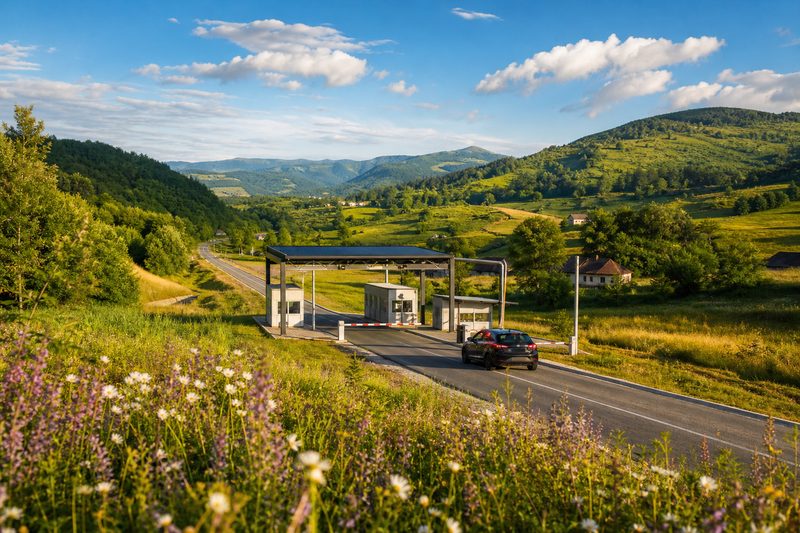
Most of this site is about the border as a place. This article is about the border as a process - the customs machinery that decides how fast a truck moves from one of the crossing points into the single market. Customs work at an external border looks local: one lane, one officer, one scanner. But the risks that arrive at that lane are anything but local, and for most of a decade the states along the eastern frontier answered that mismatch with a joint expert team.
Why customs administrations team up
Between 2016 and 2025, the customs administrations of Finland, Estonia, Latvia, Lithuania, Poland, Hungary, Slovakia, Croatia, Romania, Bulgaria and Greece ran a joint expert team for the EU's eastern and south-eastern land border, known as CELBET. It worked under the supervision of the European Commission's Directorate-General for Taxation and Customs Union and was funded through the EU customs cooperation programmes.
The premise was simple: instead of eleven administrations analysing the same threats, buying similar scanners and writing similar training courses in parallel, a pooled team of practitioners could do it once, and do it better. The team was not a new agency. Officers stayed employed by their national administrations and brought operational experience into a shared structure - a way of working the EU calls an expert team, sitting somewhere between a project group and a permanent institution.
What happens at the line
The diagram shows the logic every goods vehicle passes through at a road crossing. The stations matter less than the decision in the middle: risk selection. No crossing has the staff to open every truck, so the real work is deciding which vehicles to look at. Pre-arrival data, declared cargo, route history and shared risk profiles produce that decision long before an officer approaches the vehicle. A well-run crossing is one where the green lane is fast because the selection is sharp.
The six working areas
The cooperation was organised into six teams, and the division of labour explains fairly precisely what running a land border involves.
Risk management
This team collected the threat assessments that different organisations publish about the region and merged them into integrated pictures for the eastern land border. It defined shared risk profiles, adjusted them as routes shifted, and proposed joint intensified activities - coordinated control operations that were run together with Frontex and Europol.
Customs controls
The controls team looked at method: how the level of smuggling at crossing points can actually be measured, what customs can contribute to policing the green border between crossings, and how detection equipment is used in practice. Its output fed a shared handbook of operational customs controls, updated with collected best practice.
Equipment
Scanners, density meters, endoscopes and detector-dog programmes are expensive, and the traffic profile of every crossing is different. The equipment team kept an inventory of control and detection technology across the border, matched equipment sets to risk and traffic at each crossing point, and drafted recommendations for coordinated procurement and maintenance.
Training
The training team built a common system for land-border customs officers, so that an X-ray image analyst in Romania and one in Lithuania work to the same standard. The courses that came out of it - X-ray image analysis, bus search, detection-dog work - were taught in mixed international groups, often in dedicated centres of expertise near the border, such as the training site at Przemysl a few kilometres from the Medyka crossing.
Crossing-point evaluation and management
This team developed uniform standards for measuring how a border crossing point performs, and ran structured site visits and diagnostic studies - including a pilot study at Medyka - that tested those standards against reality: layout, lanes, staffing, equipment and the processes between them.
Cooperation
Customs shares every crossing with border guards, and every border with a neighbouring administration on the other side. The cooperation team handled both interfaces: joint working methods with border guard services inside the EU, and contact with the customs services of third countries, including training webinars for Ukrainian and Moldovan officers.
Team names shifted slightly between project phases, but the six working areas stayed remarkably constant across the years - risk, controls, equipment, training, evaluation, cooperation.
What the model produced
The concrete outputs are easy to list: integrated threat assessments, shared risk profiles, a common training curriculum, an equipment inventory with procurement recommendations, uniform performance-measurement standards, and a series of joint control operations. The less tangible output mattered at least as much - a network of officers across eleven administrations who know each other, use the same vocabulary and can pick up a phone when a route shifts.
The mandate concluded in 2025, with the final steering committee meeting held that February. The working methods it established - pooled analysis, mixed international training, crossing-point evaluation against common standards - remain the reference for how the eastern crossings are run and assessed. For the places themselves, go back to the crossing-point tour; for the regions around them, see life along the border.